The 730-Day Rule Is a Moving Window, Not a Countdown
The short version
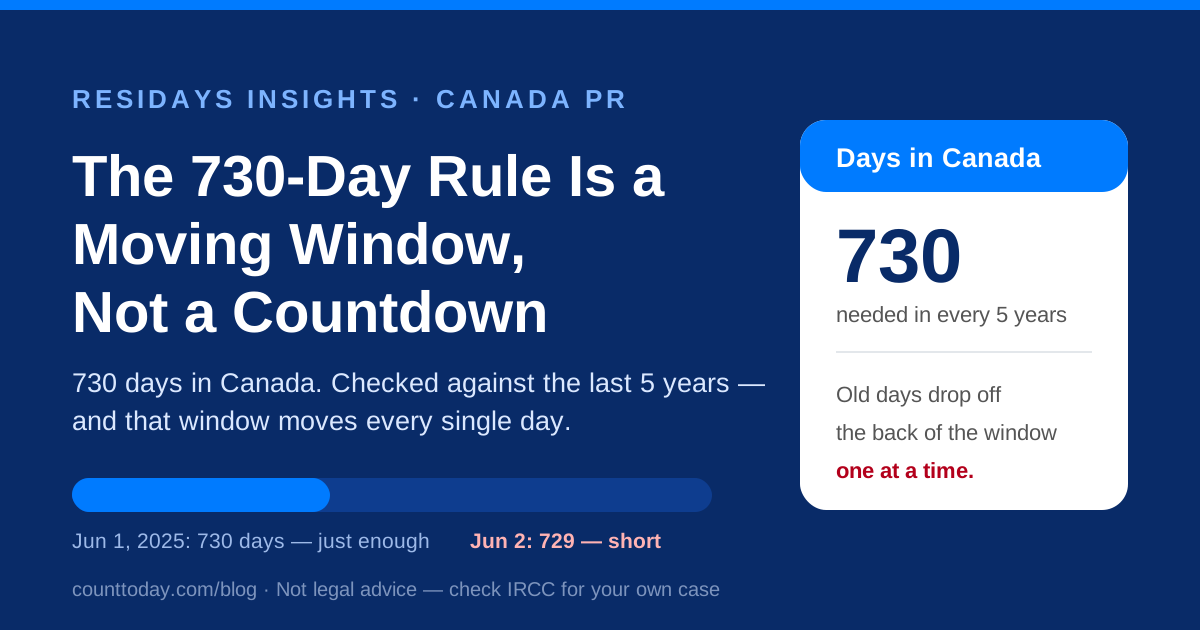
- You need 730 days in Canada in the 5 years before the day anyone checks — not 5 years from landing, not 5 years from your card.
- The window moves daily. Each day you stay away, one old day in Canada falls off the back.
- You can pass on a Monday and fail on a Tuesday without taking a trip. Example below.
Most permanent residents describe the rule the same way: land, live in Canada 2 years out of 5, renew the card, repeat. A block of time with a start and an end.
That is not how IRCC counts it. The gap between those two versions is where people lose status.
What IRCC actually checks
Section 28 of the Immigration and Refugee Protection Act says a PR must be in Canada at least 730 days in every 5-year period. IRCC's help page puts it plainly: 730 days during the last five years, and they do not have to be in a row.
Last five years counted back from when? From the day you get checked. That happens at three ordinary moments: you apply to renew your PR card, you apply for a travel document (PRTD) from abroad, or an officer asks about your status when you enter Canada.
Been a PR for less than 5 years? The test is softer: can you still reach 730 by your fifth anniversary? Once that anniversary passes, the soft version ends.
A worked example, with real dates
A PR lands on June 1, 2020, lives in Canada for two solid years, then moves back to her home country for work, meaning to return later.
| Date | What the count looks like |
|---|---|
| Jun 1, 2020 – May 31, 2022 | In Canada the whole time. 730 days. |
| Jun 1, 2022 onwards | Living outside Canada. No new days added. |
| Checked on Jun 1, 2025 | Days in the last 5 years: 730. Passes, with nothing to spare. |
| Checked on Jun 2, 2025 | Her first day in Canada has fallen off the back of the window. Days: 729. Short. |
| Checked on Jul 1, 2025 | Thirty more of her 2020 days have fallen off. Days: 700. |
Nothing changed in her life between June 1 and June 2. No flight, no missed deadline. The window moved by one day, and that was enough.
Two cases from r/ImmigrationCanada
Drawn from public threads posted between June 2025 and October 2026, linked at the end. No names; some details combined.
1. The family counting to the wrong date
A family got PR in March 2023, spent about a month in Canada, and went back abroad so one of them could finish a PhD. Plan: move for good in late 2026 or early 2027. Their cards run to 2028, which felt safe. Their own count said they would land 4 to 5 months short of 730. The thread kept returning to one point: the date that matters is the fifth anniversary of becoming a PR, not the date on the card. If 730 is still reachable, move sooner — every month abroad pushes the recovery date out a month. The poster later made a short visit to Canada with no trouble at entry, and still called the situation risky. Both can be true. That is this rule in one sentence.
2. Ninety days short, and he gave the PR up
Another poster had spent 1,180 days outside Canada in five years — about 90 days short. His card was still valid, and his last two flights in had been nothing more than a kiosk scan. He asked if landing at Vancouver would get him flagged this time. The answer: once 730 can no longer be reached inside the window, a referral to an officer gets much more likely, past easy entries or not. His update ended it. He decided not to travel, stayed abroad, and let the PR go. Ninety days was the whole margin.
The days abroad that do count
Time outside Canada can still count toward the 730 if you are living abroad with a Canadian citizen spouse or partner, you are a child living with a Canadian citizen parent, or you work abroad full-time for a Canadian business or a Canadian government — or you live with a PR spouse or parent who does. Read that narrowly. Working remotely for a Canadian employer from another country is not the same as being posted abroad by one, and officers ask for proof.
One point that helps at the margins: if you were in Canada for any part of a day, that day counts. The day you leave and the day you return both count. On a close count, those two days can be the whole argument.
If you are already short
An expired card is not expired status. Status is lost through a formal process, not by a date on plastic.
A short count can also fix itself — if you come back and stay. Each day in Canada adds a day, and old absences fall out of the window in time. The advice in thread after thread is the same: get back, stay put, and do not file anything that invites a check until you are over the line. One catch from the threads: if an officer writes a section 44 report at entry, the picture changes fast and an appeal clock starts (30 days for a departure order made in Canada). That is the point to get a lawyer, not a forum.
Outside Canada and short? You need a PRTD to fly back, and that application is itself a check. If it is refused, there is an appeal, generally 60 days when the decision was made abroad, and humanitarian grounds can be argued there. Set expectations, though: in one thread, a couple hoping to rely on job trouble in Canada and a mortgage in the US were told, consistently, that financial hardship on its own is a weak ground. Medical crises, events outside your control, and the effect on children carry more weight.
Count the window before it moves
ResiDays tracks your days in Canada and the US on your iPhone, with your 730-day and 1,095-day goals in view and your travel history imported from I-94. Your data stays on your device. No account, no server.
Download ResiDays on the App Store
Or run a quick one-off count with our free Canada Days Calculator.
Quick questions
Does a new PR card reset the count?
No. Nothing resets. The test runs on the day you are examined, card or no card.
Short — should I renew right away and explain?
If you are in Canada, the pattern that works is to wait until you are not short. Applying early hands IRCC a reason to look.
Do days with my Canadian spouse abroad count toward citizenship?
No. They can count toward keeping PR. Citizenship counts days actually in Canada: 1,095 of them.
How do I keep a count I can defend?
Save boarding passes and booking emails as you go, pull your I-94 history if you cross into the US, and keep a dated list of entries and exits. Memory plus a spreadsheet, two years later, is how most bad counts happen.
Sources
- IRCC Help Centre: How long must I stay in Canada to keep my permanent resident status?
- IRCC: Renew your PR card
- Immigration and Refugee Protection Act, section 28
- r/ImmigrationCanada: “PR residency obligation not met” (March 2026)
- r/ImmigrationCanada: “YVR Landing as PR without meeting Residency Obligation 730 days” (June 2025)
- r/ImmigrationCanada: “Maintaining 730 days PR residency requirements” (October 2026)
- r/ImmigrationCanada: “PR since April 2024, will fall well short of 730-day residency obligation by 2029” (July 2026)
Disclaimer: This article is general information about how a rule is usually counted. It is not legal, immigration, or tax advice. Residency decisions turn on your exact dates and documents. Check the official sources above, and if your status is at risk, talk to a licensed Canadian immigration lawyer or a regulated immigration consultant before you apply for anything.