Border Waits: Check the Forecast, Then Check the Camera
The short version
- One live wait number is the last check, not the first. Forecast picks your hour, live wait confirms it, the camera shows you the queue.
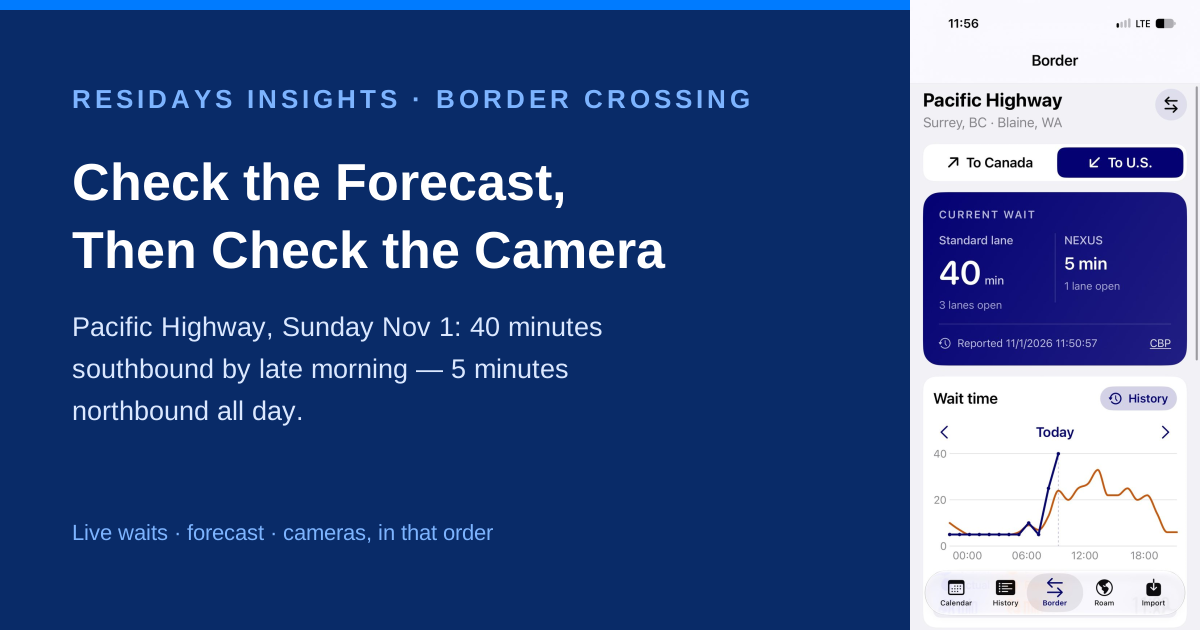
- Sunday, Nov 1 at Pacific Highway: southbound hit 40 minutes by late morning. Northbound sat at 5 minutes all day.
- That morning's forecast said mid-20s. The real line ran hotter — which is why the order matters.
Most people check the border once: one wait number, as they get in the car. Sunday, November 1 at Pacific Highway (Surrey, BC · Blaine, WA) shows what that misses. The same crossing was two different trips depending on direction — and the forecast, the number most people trust, undershot the real wait.
One Sunday, two directions
Southbound, into the U.S., the actual wait sat near 5 minutes until about 7 a.m., then climbed steeply. By CBP's 11:50 a.m. report the standard lanes were at 40 minutes, 3 lanes open. NEXUS, on 1 lane, was 5 minutes. The afternoon forecast ran in the 20s to low 30s, easing late in the evening.
Northbound, into Canada, CBSA reported 5 minutes in the standard lanes at 12:40 p.m., under 5 for NEXUS. The actual line never got past about 3 minutes all morning, and the afternoon forecast peaked near 9 minutes. No drama at all — in the other direction.
The three checks, in order
1. The forecast, the night before. The orange line is the day's shape: when the wait builds, how high it gets, when it falls. Sunday's southbound shape said the whole middle of the day was spoken for. Use it to pick: go early, or go late.
2. The live wait, before you leave. The reported minutes, the lanes open, and the time of the report. Both agencies update at least hourly and call their numbers estimates: a 40-minute report from 11:50 describes the line then, not at 1 p.m.
3. The camera, before you commit. Camera stills show the thing a number cannot: how far the queue backs up. The DriveBC Pacific Highway camera at 12:55 and 1:12 p.m. showed the southbound approach stacked with cars — the picture matched the 40-minute number.
When the forecast undershoots
Sunday's southbound forecast for mid-morning was about 24 minutes. The actual wait reached 40. Forecasts are built from history and patterns; a travel weekend, a lane change, or a slow inspection lane can push a real day past them. Treat the forecast as a plan you re-check, not a promise. When the live number and the forecast disagree, believe the live number — and look at the camera.
One more thing on clock-change weekends
Nov 1 was also the morning the U.S. went back to standard time while B.C. stayed on Pacific Time, leaving the two sides an hour apart. It even shows in the feeds: one report stamped PDT, a camera still stamped PCT. That weekend, check which clock a reported time is on before you do the math.
All three checks in one tab
ResiDays' Border tab puts live waits from CBP, CBSA, and WSDOT, the actual-vs-forecast chart with history, and the traffic cameras in one place — next to your Canada and U.S. residency day counts. Your data stays on your device. No account, no server.
Download ResiDays on the App Store
Or keep your U.S. days counted with our free U.S. Days Counter.
Quick questions
Peace Arch or Pacific Highway — which is faster?
There is no fixed winner. The two crossings sit a few minutes apart, and the faster one changes by hour and by direction. Compare both live waits before you choose, not from habit.
How often are wait times updated?
CBP and CBSA update their estimates at least once an hour. Treat every number as a recent estimate, not a promise: an event, a lane closure, or a secondary inspection can move it within the hour.
Is NEXUS always faster?
Usually by a lot — on Nov 1 it was 5 minutes against 40 in the standard lanes. But NEXUS ran on a single open lane that morning, so check its live number too instead of assuming.
Sources
- CBP: Border Wait Times
- CBSA: Border Wait Times
- Data above: ResiDays Border tab, Pacific Highway, November 1, 2026 (CBP, CBSA, WSDOT, DriveBC)
Disclaimer: This article is general information, not travel, legal, or tax advice. Border wait times are estimates and can change within the hour. Check the official sources above before you drive.