The Substantial Presence Test Is Not a 183-Day Rule
The short version
- The substantial presence test is a weighted 3-year count, not 183 days in one year.
- All of this year, 1/3 of last year, 1/6 of the year before: 183 or more, with at least 31 days this year, makes you a tax resident.
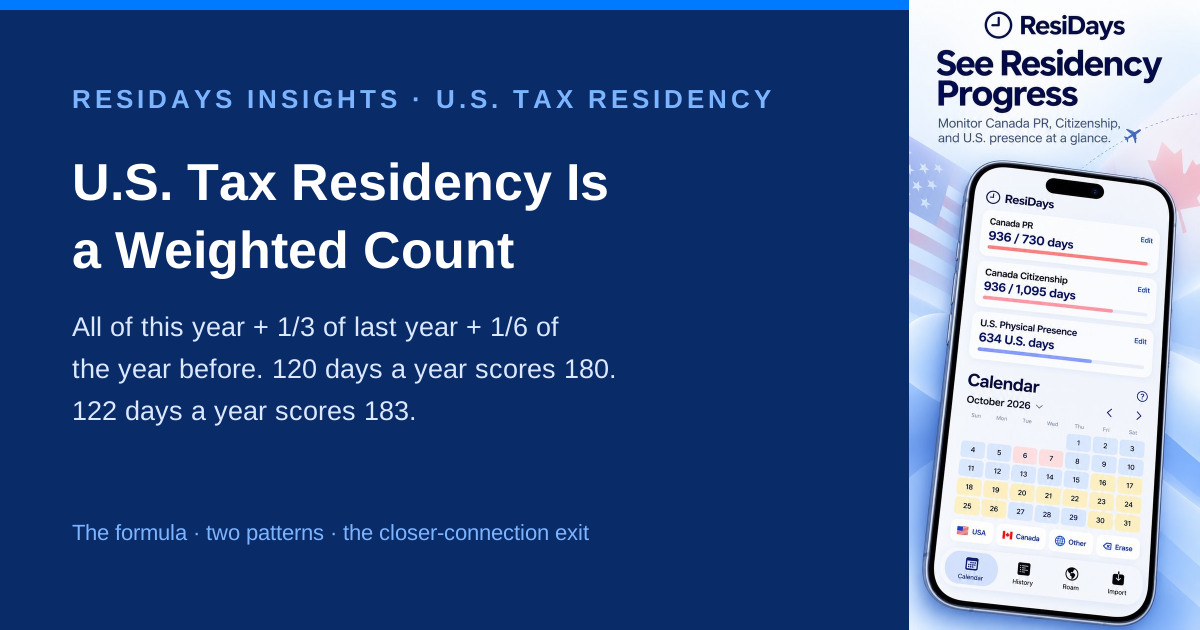
- 120 days a year scores 180. 122 days a year scores 183.
Many Canadians and frequent visitors use the same rule of thumb: stay under 183 U.S. days a year and you stay a nonresident for tax. That is not the test. The IRS count reaches back three years and weights the days, so people cross the line at 122 days a year while watching the wrong number.
How the count works
Two things must both be true for a calendar year: at least 31 days in the U.S. that year, and a weighted 3-year total of 183 — every day this year, plus 1/3 of last year's days, plus 1/6 of the year before.
"Present" is read broadly: any part of a day in the U.S. counts as a full day, unless an exception takes it out. A two-hour shopping run across the border is a day.
The IRS example, and the two days after it
The IRS guide works this example: 120 days in the U.S. in each of three straight years scores 120 + 40 + 20 = 180. Not a resident. Add two days a year and the same math gives 122 + 40.7 + 20.3 = 183 — a tax resident, filing on worldwide income, without one year coming close to 183.
Pattern: the snowbird who never hit 183
A Canadian who winters in Florida 150 days a year never reaches 183 in a single year, and feels safe. The weighted count is 150 + 50 + 25 = 225: the test is met. The way out is the closer connection exception — under 183 actual days this year, a tax home in Canada all year, closer ties to Canada than to the U.S. — claimed on Form 8840, every year. Miss the form and the exception is gone.
Pattern: "exempt" that does not mean tax-free
Students on F or J visas, and teachers and trainees on J or Q visas, are often "exempt individuals." The word misleads: exempt covers the day count only, so those days leave the test. It says nothing about tax on income. The status must be claimed on Form 8843 each year, even with no U.S. income, and it runs out after a set number of years. When it ends, the days start counting, and a settled routine can tip someone past 183.
Count your own three years
You need entry and exit dates for three calendar years, not one. Your CBP I-94 travel history lists U.S. arrivals and departures: pull it, score each year, and run the weighted total before booking the next long stay. Each January the oldest year drops out and the weights shift, so last year's safe pattern is not this year's answer.
Your U.S. days, counted as you go
ResiDays imports your I-94 history and keeps your U.S. presence count running on your iPhone, next to your Canada counts. Your data stays on your device. No account, no server.
Download ResiDays on the App Store
Or run a quick one-off count with our free U.S. Days Counter.
Quick questions
Do day trips to the U.S. count?
Yes — any part of a day counts, even an hour. One exception helps cross-border workers: residents of Canada or Mexico who regularly commute to a U.S. job do not count their commuting days.
I was in the U.S. for 180 days this year. Am I safe?
Not on that fact alone: add a third of last year's days and a sixth of the year before, and the total is almost surely past 183. One year's number never decides this test.
What if I hold a green card?
Then the day count does not matter: under the separate green card test, a lawful permanent resident is a U.S. tax resident no matter how few days they spend in the country.
Sources
- IRS: Substantial Presence Test
- IRS Publication 519: U.S. Tax Guide for Aliens
- CBP: I-94 travel history
Disclaimer: This article is general information, not legal, immigration, or tax advice. Decisions turn on your exact dates and documents. Check the official sources above, and if your status is at risk, talk to a licensed cross-border tax professional before you file.