Before You Renew Your PR Card, Run This Self-Check
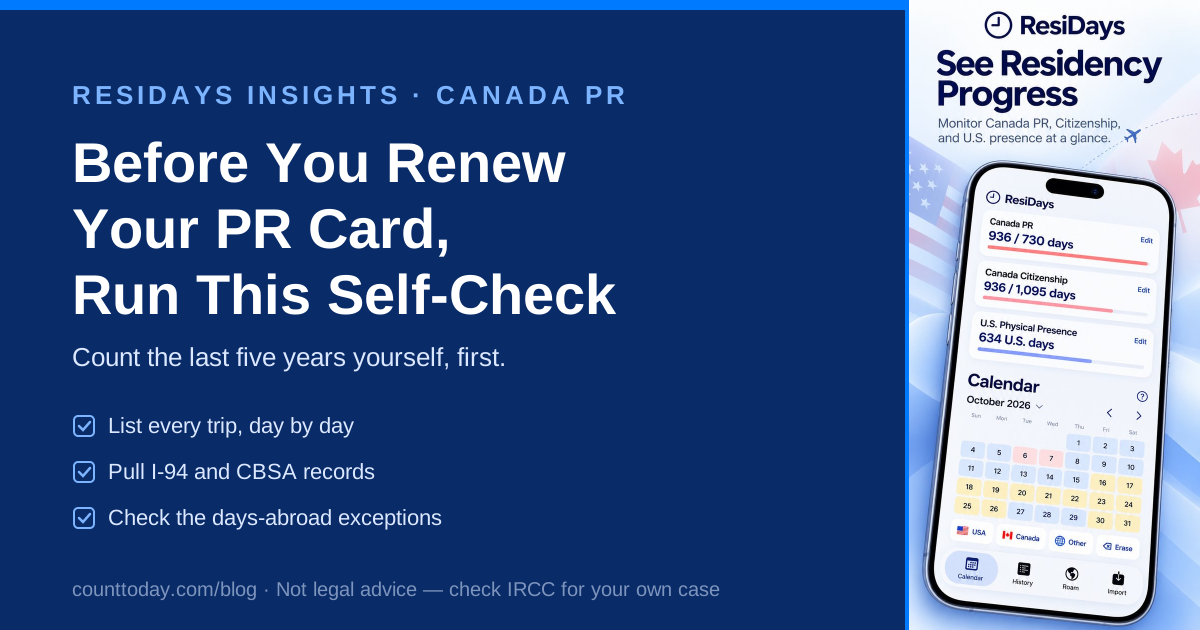
The short version
- IRCC counts the 5 years right before your application — or before the day an officer checks you at the border. You need 730 days in Canada inside that window.
- You can rebuild the count yourself in one sitting: list every trip, then check the list against your I-94 history, your CBSA record, and your own paper.
- If the count comes up short, the fix is usually time, not paperwork: stay in Canada and let the window roll until you cross 730 again.
Renewing a PR card looks like a formality: fill in the form, pay the fee, wait for the plastic. But the application is one of the moments IRCC actually counts your days — and if the count fails, the form was never the problem. So run the count yourself first, while you can still act on the answer. One sitting, three steps. The same check is worth doing before any long trip.
Step 1 — Count the window, not the card
Pick the day you expect to be checked — the day you would file, or the day you would fly back from a long trip — and count back exactly 5 years. That span is the test. Not the dates on your card, not the year you landed.
List every absence in the window: date out, date back. One rule works in your favour: any part of a day in Canada counts as a day in Canada. The day you leave counts, the day you return counts; only full days outside come off the total.
Days in Canada = the days in the window minus your full days outside. Compare with 730 — and be strict about the margin. Within about 30 days of the line, either way, the count is unproven until Step 2 confirms it. Memory is where these counts go wrong.
A PR for less than 5 years? Different test: can you still reach 730 by your fifth anniversary? Count forward instead.
Step 2 — Pull the records that prove it
Start with what you already have — passport stamps, boarding passes, booking emails — and mark every trip on your list that has no paper behind it. The next two records exist for those gaps.
I-94 travel history (U.S.). CBP's I-94 site shows your recorded U.S. arrivals and departures. If you cross the border often, it is the fastest cross-check there is: every U.S. entry is a day you left Canada, with the government's dates, not your recollection.
CBSA Traveller History Report. Canada's own record of your entries — and your exits, if you ask for exit information specifically. Your own report is free under the Privacy Act, and CBSA says it can take up to 30 days. Order it while you still have time, not the week you plan to file.
Backfill the rest. Leases, pay stubs, tax assessments, bank and card statements place you in Canada on days with no stamp. And yes, the renewal form lets you consent to IRCC pulling your CBSA report themselves — but run your own count first. Their copy should not be the first version of your history you ever see.
Step 3 — Check the exceptions before you worry
Some days outside Canada still count: living abroad with a Canadian citizen spouse or partner (or a Canadian citizen parent, for a child); working abroad full-time for a Canadian business or government that sent you there; or living with a PR spouse or parent in that kind of job.
Read it narrowly — remote work for a Canadian employer from abroad is not a posting, and officers ask for proof: an assignment letter, pay records, dates. These exceptions protect PR status only. Citizenship counts days actually in Canada, 1,095 of them.
If the count comes up short
Recount first, with the records in hand. Most short counts are record problems — a return nobody stamped, a day trip nobody wrote down, the any-part-of-a-day rule never applied — and a careful recount moves the number.
Still short, and in Canada? Stay. Do not file yet, and do not travel. The count heals a day at a time as old absences roll out of the window. Find the exact date you cross 730 again and plan around it.
Outside Canada and short is harder: flying back takes a valid PR card or a permanent resident travel document, and that application is itself a residency check; at the border, questions can lead to a section 44 report. Get advice before you move, not after.
Whatever your number, start keeping the raw material now — boarding passes, booking emails, one running list. The next count should take minutes.
Do the check once — then keep it running
ResiDays tracks your days in Canada and the US on your iPhone, with your 730-day and 1,095-day goals in view and your travel history imported from I-94. Your data stays on your device. No account, no server.
Download ResiDays on the App Store
Or run a quick one-off count with our free Canada Days Calculator.
Quick questions
When should I run this check?
Twice: before you file a renewal, and before any long trip if your count is anywhere near the line. The window is measured back from the day of the check, so a count that passes today can fail after one more month abroad.
My passport is missing stamps. Is the count hopeless?
No. Stamps are one record among several: I-94 history, a CBSA Traveller History Report, boarding passes, leases, pay stubs, tax assessments. Build the list from all of them.
Do days with my Canadian spouse abroad count toward citizenship?
No. They can count toward keeping PR. Citizenship needs 1,095 days of physical presence in Canada.
Sources
- IRCC Help Centre: How long must I stay in Canada to keep my permanent resident status?
- IRCC: Renew your PR card
- Immigration and Refugee Protection Act, section 28
- CBSA: Travel History Report — how to request your entry and exit records
- U.S. Customs and Border Protection: I-94 website — view travel history
Disclaimer: This article is general information about how a rule is usually counted. It is not legal, immigration, or tax advice. Residency decisions turn on your exact dates and documents. Check the official sources above, and if your status is at risk, talk to a licensed Canadian immigration lawyer or a regulated immigration consultant before you apply for anything.