Pick Your Crossing From History, Not From One Live Number
The short version
- One live number is a snapshot. History — same crossing, direction, and kind of day — picks your hour.
- Read the shape of the day, not just the peak; and check whether the NEXUS gap is stable.
- New trap: the two sides now run an hour apart — chart times need a second look.
One live wait number tells you what the border looks like right now — nothing about what it will look like when you get there. For that you need history: the same crossing, the same direction, on days like yours.
Sunday, November 1 at Pacific Highway shows why one day is not a pattern — and why a pattern beats any single number.
One Sunday, and what it does not prove
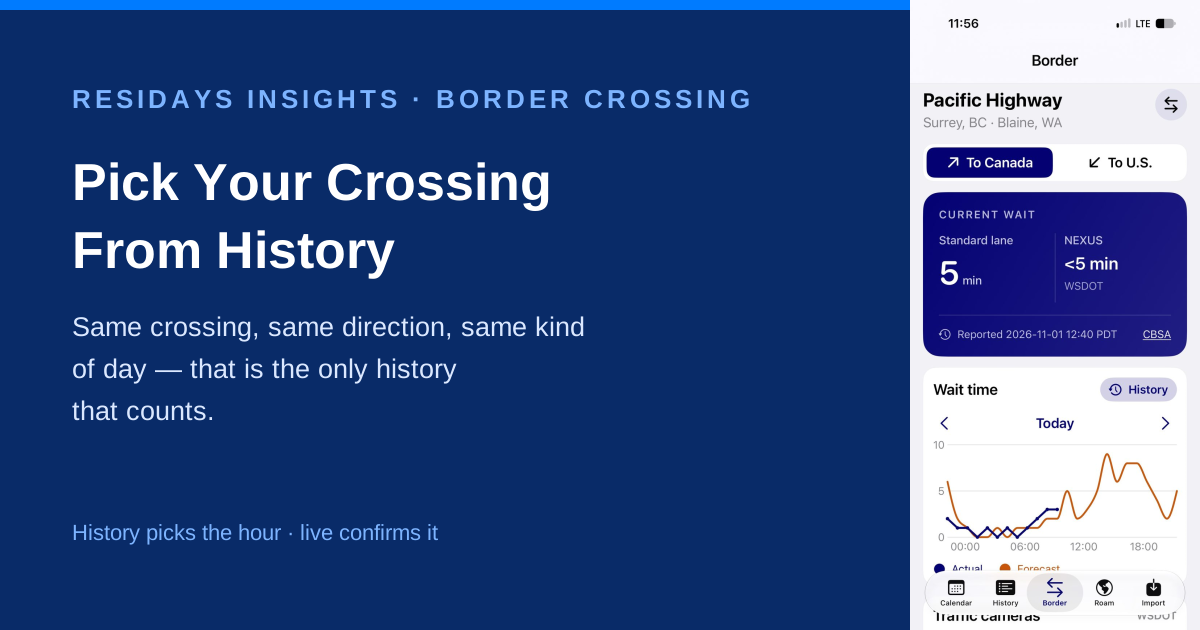
Southbound on November 1, the standard lanes sat near 5 minutes until about 7 a.m., then climbed to 40 minutes by the 11:50 a.m. report. NEXUS was 5 minutes. Northbound was a different trip entirely: 5 minutes at 12:40 p.m., and the actual line never passed 3 minutes all morning.
The lesson is not "Pacific Highway takes 40 minutes on Sundays." Direction matters more than the crossing's name. One day gives you a shape. Several days give you a rule.
Three habits for reading history
1. Compare like with like. Stack up only the same crossing, direction, and kind of day. Weekday and weekend are different borders; so are the two directions — November 1 proved that in both directions at once.
2. Read the shape, not just the peak. The useful question is not how bad it gets, but when it starts climbing and when it falls. On November 1 the southbound climb began around 7 a.m. So: leave before the climb, or after it eases.
3. Check whether the NEXUS gap is stable. On November 1 it saved 35 minutes southbound (5 against 40). But that gap runs on a single lane, which is the risk: if the lane closes, the gap can vanish in one update. Check it across several days: steady at 5, trust it; swinging, treat it as a bonus.
The new trap in the history charts: the one-hour gap
Since November 1, the two sides of this border no longer share a clock. B.C. stays on Pacific Time year-round now (UTC-7); Seattle fell back to standard time. Burnaby and Vancouver run one hour ahead of Seattle until the U.S. springs forward on March 14.
A wait chart is stamped in local time: a 9 a.m. peak on the B.C. side is 8 a.m. on the Seattle side. Mix them up and you aim for a quiet hour that already passed. Check which clock each number is on — and set your departure by the clock on your side.
How to use it before your next crossing
In ResiDays Border, pick your crossing and direction, look back at the last few same-type days, and read their shape. Then, on the day itself, check the live wait and the camera before you leave. History picks the hour. The live number confirms it.
A single number is a snapshot. History is the habit. Cross often enough and the pattern starts telling you when to go.
History, forecast, and live waits in one tab
ResiDays' Border tab keeps history and forecast charts next to live waits from CBP, CBSA, and WSDOT — and next to your residency day counts, tracked automatically with crossings imported from photos. Your data stays on your device. No account, no server.
Download ResiDays on the App Store
Start with our free Canada Days Counter.
Quick questions
How many days of history should I look at?
The last few of the same kind: same crossing, same direction, weekday for weekday, weekend for weekend.
Is early morning always the best time to cross?
Usually two windows work: before the climb starts, or after it eases. On Nov 1 the southbound climb began around 7 a.m.
Why do wait charts on the two sides show different times?
Since Nov 1, B.C. stays on Pacific Time (UTC-7) while Seattle is on standard time (UTC-8) — an hour apart until March 14. Charts use local time.
Sources
- CBP: Border Wait Times
- CBSA: Border Wait Times
- Data: ResiDays Border tab, Pacific Highway, Nov 1, 2026
Disclaimer: This article is general information, not travel, legal, or tax advice. Border wait times are estimates and can change within the hour. Check the official sources before you drive.